
Actions module
Actions that do not stall in a list
The most common problem in a management review is not the number of findings, but that nobody can say how many actions were actually closed effectively.
Why actions are the real bottleneck
Recording findings is the easy part. The hard part starts afterwards: an action needs an owner, a due date, an implementation, evidence, and an assessment of whether it worked. Each of those five steps is a place where the item can stall.
In spreadsheets and email threads that happens systematically, because nothing actively demands the next state. A row in a spreadsheet reminds nobody.
What the module does
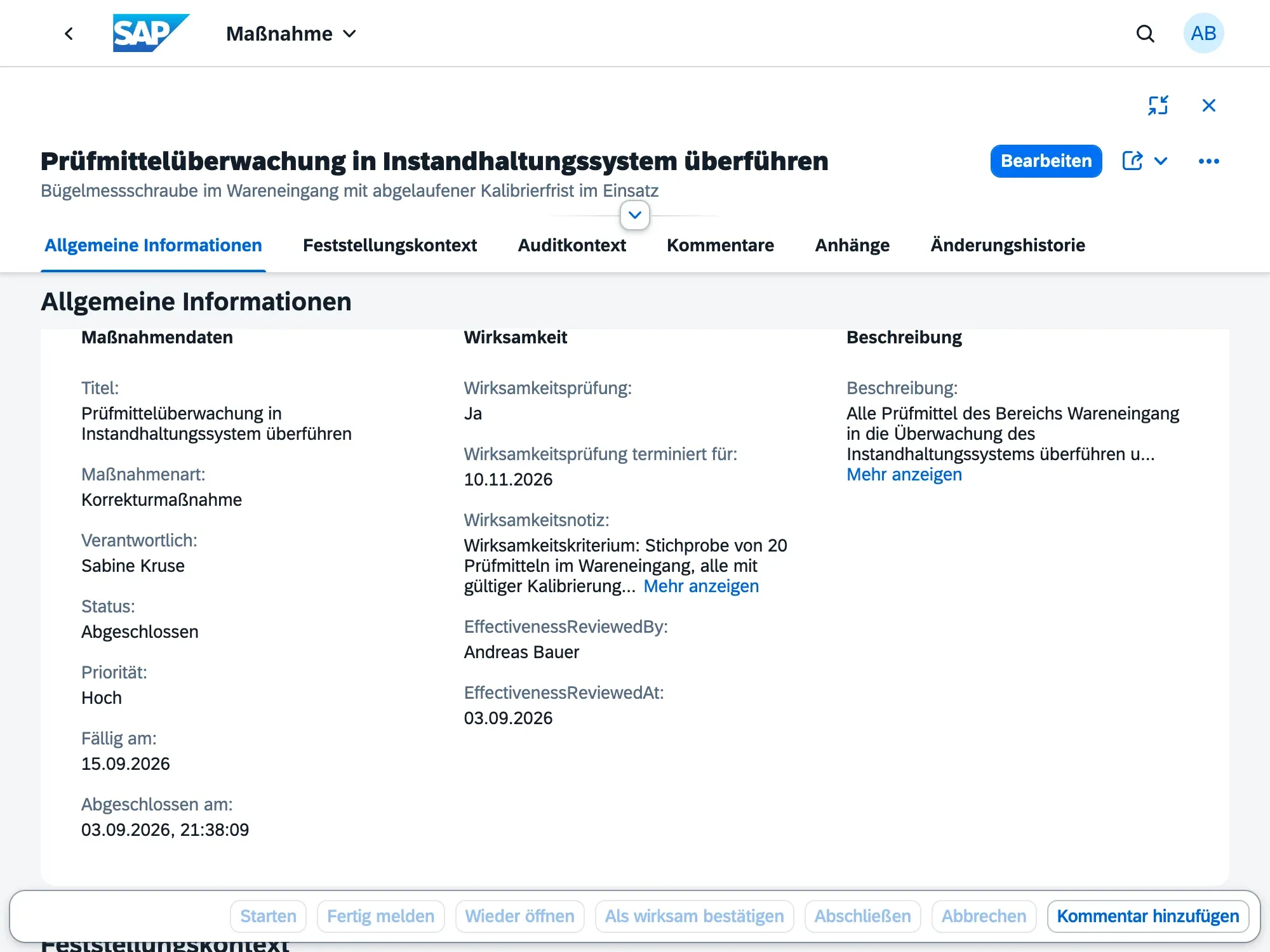
One place for every action. Whether an action comes from an audit finding, an 8D analysis or a process deviation, it appears in the same personal task list. For departments that is the decisive point: one list, not five.
Action types that mean different things. Correction, corrective action and preventive action are distinct — ISO 9001 clause 10.2 separates them explicitly. The model reflects that distinction instead of treating everything as a “task”.
The effectiveness check as a mandatory step. Moving to “closed” requires the documented assessment. That makes the management-review question answerable without a week of data collection first.
Metrics instead of impressions. Open, overdue and effectively closed actions can be analysed — by area, period and origin.
A complete history. Every status change, date shift and reassignment is logged and traceable in an audit.
The link backwards and forwards
Backwards, an action hangs off its trigger — the audit finding or the root cause analysis. Forwards, it supplies the data basis for the management review under ISO 9001 clause 9.3.
Those two links are exactly what is lost as soon as actions are kept in a separate tool. That is why action management in qportal is not an appendage of the audit module but a portal-wide foundation.
Frequently asked questions
- What does CAPA mean?
- CAPA stands for Corrective and Preventive Action. The term covers the process by which a detected nonconformity is resolved at its cause and its recurrence prevented.
- Audit findings only, or beyond that?
- Portal-wide. Actions arise from audit findings, from 5-Why and 8D analyses, or on their own. They all run through the same mechanism, so a person has one task list instead of one per source.
- How is effectiveness verified?
- The effectiveness check is its own state in the lifecycle, not a checkbox at the end. An action counts as closed only once that step is documented — precisely the step missing from spreadsheet solutions.
- Are there reminders for open actions?
- Yes. Due and overdue actions are triggered automatically so they do not sit without an active status.