
8D method
The 8D report as a guided process, not a form
In automotive, 8D is the standard for complaints and recurring defects. As a Word template, what usually survives is a filled-in cover sheet.
The eight disciplines
| Step | Content | Typical failure in practice |
|---|---|---|
| D1 | Assemble the team | One person fills in the form; the team exists only on paper |
| D2 | Describe the problem | Symptom instead of problem, without data on quantity, period and scope |
| D3 | Containment actions | Taken, but never checked for effectiveness |
| D4 | Determine root causes | Only the occurrence cause; non-detection is left unexamined |
| D5 | Plan corrective actions | Action without an owner or a due date |
| D6 | Implement and verify | Implemented, but the evidence is missing |
| D7 | Prevent recurrence | The insight never flows back into FMEA, control plan or inspection instruction |
| D8 | Close out | The report is sent, but never formally closed |
What qportal makes of it
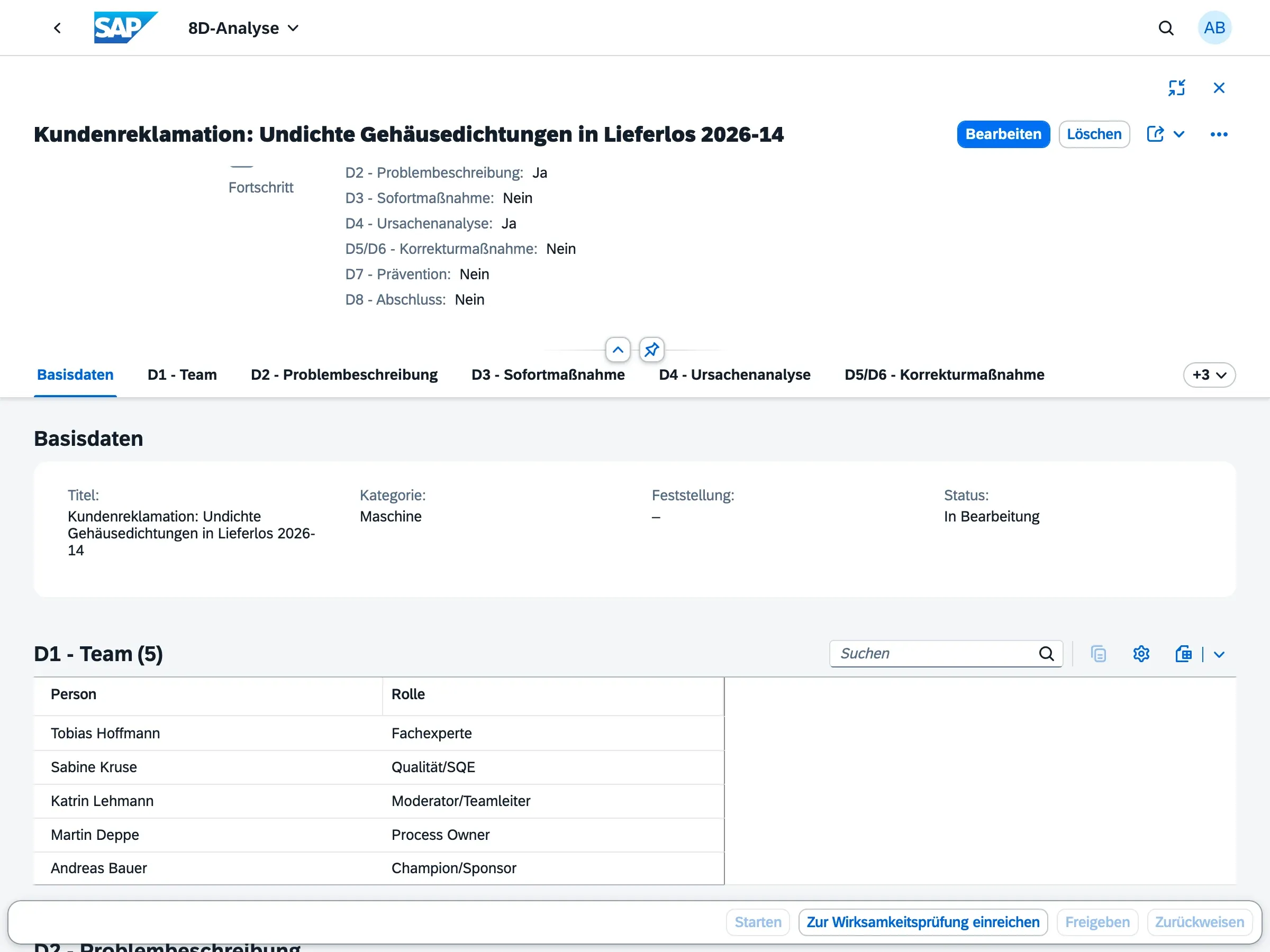
Progress visible per discipline. Completion is tracked per step rather than as a single overall status. It is therefore immediately visible where an analysis is stuck — typically between D4 and D6.
Separate causal chains. Occurrence and non-detection are maintained as distinct chains. Both generate their own actions, so inspection planning does not quietly fall off the table.
Team roles, not a name list. D1 is more than an enumeration: roles are assigned from a code list so that responsibility does not end at “everyone”.
Actions per D step. Containment from D3, corrective actions from D5/D6 and preventive actions from D7 are distinct action types sharing the same tracking mechanism in action management.
A verification gate before closure. D8 cannot be closed while the effectiveness of the corrective actions is unproven. That is precisely the step form-based processes drop first.
Where 8D reaches its limits
8D is a heavy process. For a deviation with a clear, single-stage cause it is oversized — 5-Why is the right tool there. Which method applies should depend on criteria (customer impact, safety relevance, recurrence), not on which template happens to be at hand.
Frequently asked questions
- What does 8D stand for?
- Eight disciplines: D1 form a team, D2 describe the problem, D3 define containment actions, D4 determine root causes, D5 plan corrective actions, D6 implement and verify them, D7 prevent recurrence, D8 close out and recognise the team. Some variants add a preceding D0 for immediate response.
- Does IATF 16949 mandate 8D?
- IATF 16949 clause 10.2.3 requires a documented problem-solving process that prevents recurrence, and requires customer-prescribed methods to be used — it names no specific method. 8D becomes binding through customer-specific requirements: of those published by the IATF, Ford's names 8D explicitly, with deadlines; GM's, BMW's and Mercedes-Benz's do not. In the industry, 8D is nonetheless the prevailing implementation.
- Why two separate causal chains?
- The VDA approach distinguishes the cause of occurrence from the cause of non-detection. A defect can arise because a process produces it — and simultaneously escape because inspection does not catch it. Each needs its own actions; addressing only the first chain fixes half the problem.
- Can an 8D originate from an audit finding?
- Yes. A finding from an internal or external audit can be linked as the trigger, so the connection between audit, analysis and action is preserved.