
5-Why method
5-Why: the chain down to the systemic cause
Asking why five times is quick to explain and rarely done cleanly. The most common mistake is not stopping too early — it is letting the chain end at a person.
Why the method so often runs dry
5-Why is the most accessible root cause method — and for exactly that reason the one most often applied superficially. Three patterns repeat:
The chain ends at a person. “Why was the part installed? Because the operator missed it.” Formally the analysis is five levels deep; substantively it is at zero. Human error is an intermediate step, not a cause — the real question is why the process permitted that miss.
The chain branches but is documented linearly. Real deviations often have several causes. A form with five rows forces a single line and an early choice.
The chain is never revisited. If the cause later turns out to be wrong, nobody corrects it — the filed document stays as it was.
What qportal does differently
The causal chain is maintained as a structured sequence rather than a free-text field. Each level is its own record and stays linked to the previous one. Three practical consequences follow:
- The depth is visible. You can see at which level the analysis ends, and whether that final level is a statement about a process or about a person.
- Actions attach to the level they address, not to the case in general. An action against the cause at level 4 is a different thing from containment against the symptom at level 1.
- The analysis stays editable and logged. Corrections to the chain are traceable instead of producing another file version.
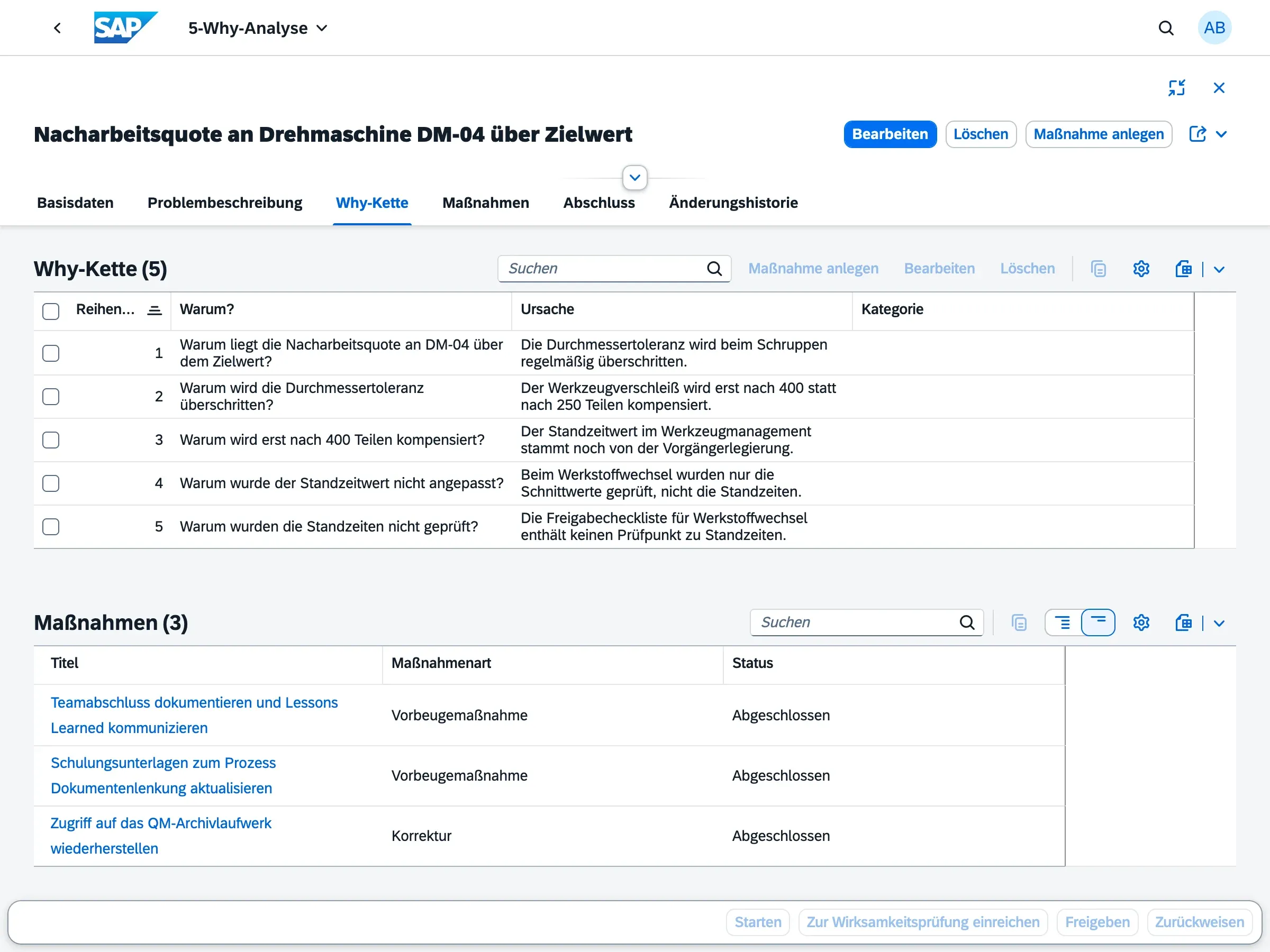
The handover to action
A root cause analysis is not an end in itself. Its result is the basis for distinguishing correction from corrective action, as ISO 9001 clause 10.2 requires. In qportal both continue in action management — with ownership, due date and effectiveness check.
For the heavier cases — customer complaint, safety relevance, recurrence — the path leads to the 8D process.
Frequently asked questions
- Does it have to be exactly five whys?
- No. Five is a rule of thumb, not a requirement. What matters is whether the chain ends at a cause within your own sphere of control whose removal prevents recurrence. Sometimes that is three levels, sometimes seven.
- How do you know a 5-Why analysis stopped too early?
- A reliable signal is a cause that points at a person — "the operator was not paying attention". That is almost never the systemic cause; it is where the analysis stopped. The next question is why the process allowed that mistake in the first place.
- When is 5-Why not enough?
- For customer complaints, safety-relevant defects, several parallel causes, or recurring problems. There the 8D process with a team, containment and verification is appropriate.