
Audit module
Audit management that carries the whole cycle
From the annual audit plan to the documented effectiveness check — without findings disappearing into spreadsheets and email threads along the way.
Why the lifecycle has to stay in one piece
ISO 9001 clause 9.2 requires a documented audit programme and retention of audit results as documented information. What the standard does not prescribe is the toolchain — and that is exactly where things break. In practice the audit plan lives in a spreadsheet, the question catalog in a Word document, the findings in a report, and the actions in yet another list.
Once those four are kept apart, one simple question can no longer be answered reliably: how many findings from the last cycle were actually closed effectively? That is not an academic question — in the management review and in the certification audit it is regularly the first one asked.
What the audit module covers
The audit programme as the structural umbrella. The programme is not a cover sheet but the level at which intervals, scope, audit teams and sites are defined. Every individual audit, every finding and every resulting action stays visibly linked to it.
Question catalogs built from audit criteria. Catalogs are assembled from a hierarchical structure of audit criteria rather than free text. Every question therefore stays connected to its clause and to the findings it produces — the mapping lives in the system, not in someone’s head.
Execution with evidence attached. Responses, ratings and evidence are captured directly against the audit item. Attachments hang off the finding rather than sitting in a parallel folder structure.
From finding to effectiveness check. A finding and its corrective action form one continuous item with a status history, not two separate records. Ownership and due dates sit on the finding, and automated reminders keep actions from stalling without an active status.
An audit-proof history. Every change is logged, so reviews and audits can trace who changed what and when.
Ready for ISO 9001:2026
For audit management, the move to the new edition is less a text problem than a data problem: until 30 September 2029, findings raised against ISO 9001:2015 and audits run against ISO 9001:2026 sit in the same data set. This is how qportal handles it:
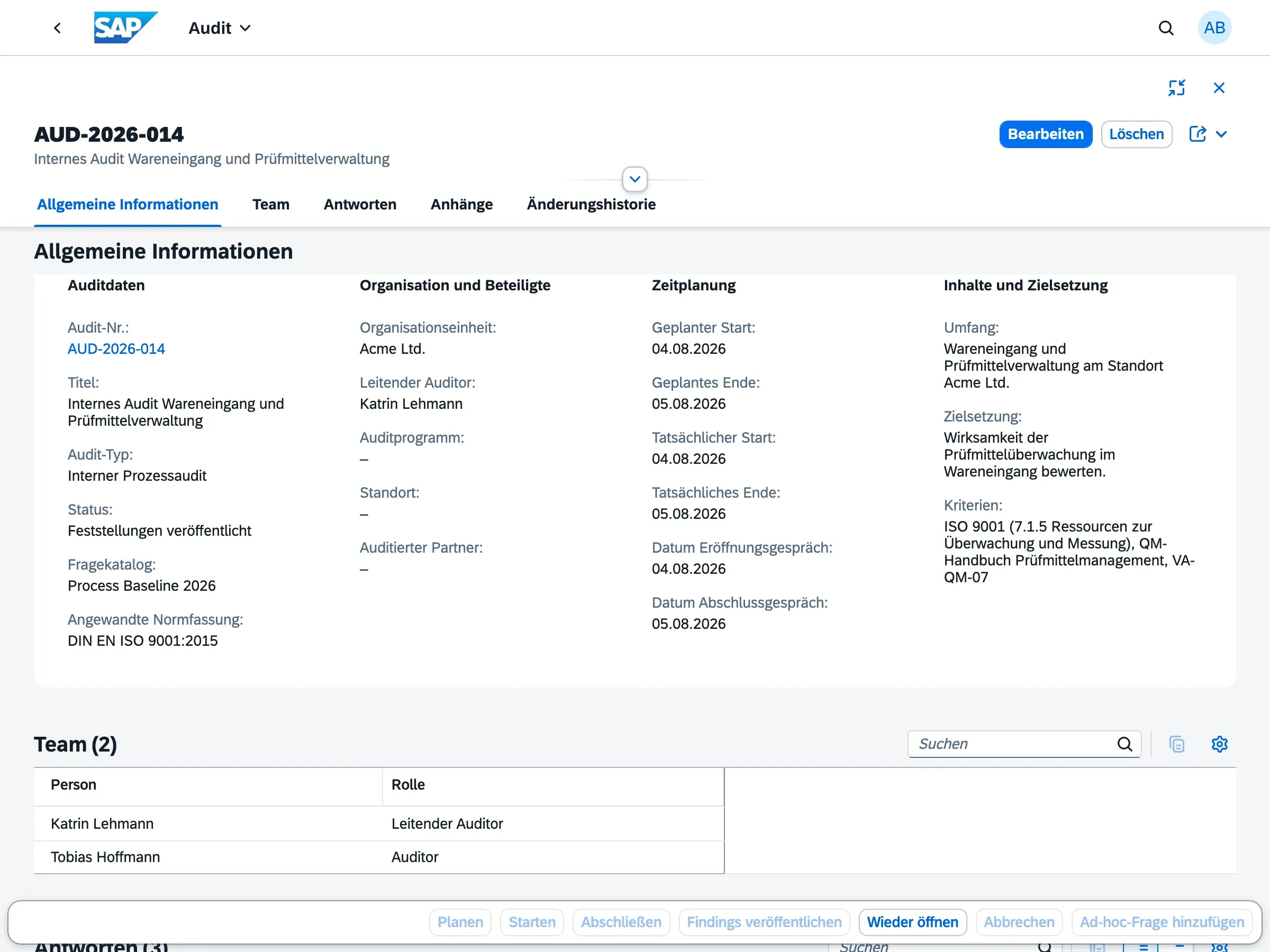
Standard versions as master data. In the app they are called Norm Standards: ISO 9001:2015 and ISO 9001:2026 are two separate criteria trees linked by predecessor, not a free-text field. Every audit is bound to exactly one applied standard version; once the audit is in progress the version is locked, because it is part of the audit evidence.
Transition workbench. The criteria of both versions are mapped to each other — identical, split (such as 6.1 into 6.1.2 and 6.1.3), merged or changed — with a transition status per criterion in both directions. New clauses without a predecessor stand out just as old ones without a successor do.
Carry the question catalog over instead of rewriting it. A catalog is copied onto the new version. Questions whose criterion cannot be resolved unambiguously are flagged as “criterion to review” instead of being guessed.
Trends across the cut-over date. Findings keep their original clause; through the mapping, analysis per requirement stays comparable anyway. That is the basis for the trends 9.3.2 asks for in the management review.
Effectiveness evidence rate. An analysis shows what share of closed corrective actions had a scheduled and actually performed effectiveness review, and how many of those were rated ineffective — the question behind 10.2.1 d). Assessment: this rate is also one of the few observable pieces of evidence for the quality culture that 5.1.1 now requires top management to promote.
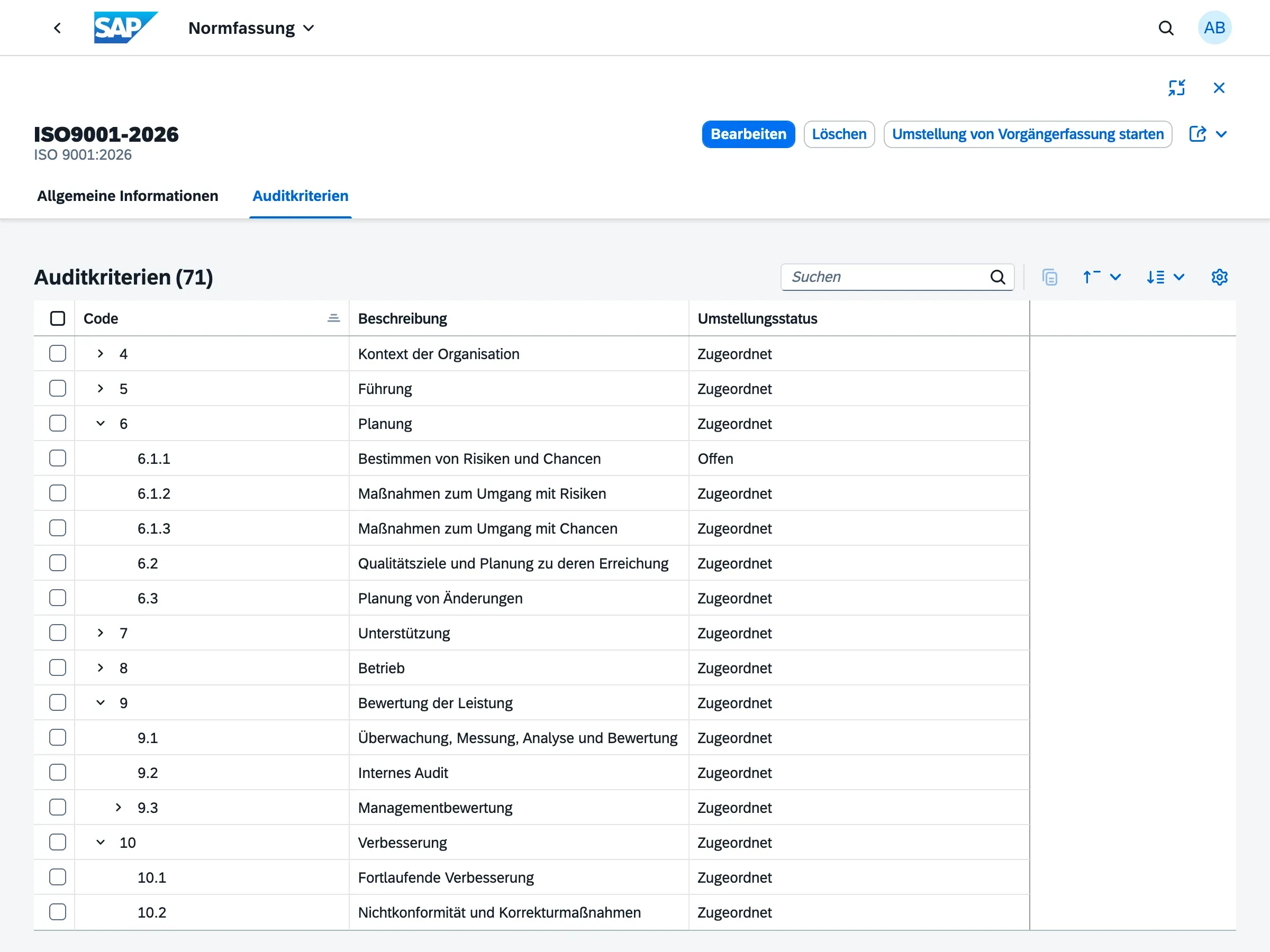
Which clauses actually change and which dates apply is on the ISO 9001:2026 overview page; setup is described in the Norm Standards documentation.
Two details that matter day to day
Auditor independence per ISO 9001 9.2.2 c) (2026 edition: b). The standard requires auditors to be selected and audits conducted so as to ensure the objectivity and impartiality of the audit process. qportal warns automatically when the auditor and the audited org unit coincide — instead of it surfacing during the external audit.
Auditee confirmation. Generating audit findings has its own subclause in ISO 19011, 6.4.8 (“Generating the audit findings”); the normative text is paywalled and is not reproduced here. In qportal, confirmation by the audited organisation is its own state in the lifecycle rather than an informal conversation.
Who this is for
Quality managers and audit managers who own the annual cycle. Auditors who work on the floor and would rather not retype their notes in the evening. Departments that get assigned an action and need to know what is expected of them by when. And leadership, which needs defensible numbers in the management review rather than collected impressions.
Frequently asked questions
- Does qportal cover both internal and external audits?
- Internal (first-party) audits and preparation for certification (third-party) audits use the same structure of audit programme, question catalog, finding and action — they are distinguished by audit type and audit criteria. Supplier (second-party) audits can be recorded in the same structure but are not yet built out specifically, for example with supplier evaluation.
- Does qportal support the transition to ISO 9001:2026?
- Yes. Standard versions are master data of their own, every audit is bound to exactly one version, and a transition workbench maps the 2015 criteria to the 2026 ones. Question catalogs are carried over to the new version; questions whose criterion cannot be resolved unambiguously are flagged for review. Existing findings keep their original clause.
- Do I need SAP to use qportal?
- No. qportal runs on SAP BTP but is also offered as a hosted service. You need neither your own BTP subaccount nor an S/4HANA system.
- How are findings linked to clauses of a standard?
- Through a hierarchical structure of audit criteria, modelled up to three levels deep. Every catalog question hangs off a criterion, and every finding inherits that link — traceability back to the specific requirement emerges automatically instead of being reconstructed by hand.
- Can auditors work on-site from a mobile device?
- Yes. The interfaces are built with SAP Fiori Elements and work on tablets and phones. Findings are captured during the audit rather than transcribed later from paper notes.