
ISO 9001 clause 6.2
Quality objectives that are kept current, not filled in once a year
Target value, ownership, and measurement frequency sit on the objective itself — the status comes from actual measurements, not from an estimate made just before the management review.
Why the annual target list keeps failing
ISO 9001 clause 6.2 requires measurable quality objectives, derived from the quality policy, with clear ownership and an evaluation of the results. In practice, what usually happens is the same pattern every time: a spreadsheet of targets set up in January, and a rushed update just before the autumn management review — with numbers nobody can reliably reconstruct by that point.
The requirement this fails on is rarely the target-setting. Objectives are almost always written down somewhere. What is missing is the record of how they developed through the year — and the clause 6.2.2 information the standard asks for about planning the achievement: which resources, who is responsible, by when, and how the result will be evaluated.
What qportal covers for quality objectives
A target metric instead of a gut feeling. Target value, baseline, direction (higher, lower, or a range), measurement frequency, and optional warning and action limits sit on the objective itself. The status of every individual measurement is derived from these automatically — not assigned after the fact.
Measurement with actual ownership. Every objective carries a responsible person who can record their own measurements directly, without routing them through the quality team first. Due and overdue measurements are visible at any time, rather than surfacing only when someone happens to open the spreadsheet.
Achievement that comes from real numbers. Progress between the baseline and the target is computed from the condensed measurement series — average, sum, last, or worst value, whichever fits the objective.
Evaluation as its own step. At the end of the period, qportal proposes an achievement status; the quality manager confirms or corrects it explicitly and records the reasoning. No silent automation, but also no number invented on evaluation day.
Carrying forward without losing progress. An evaluated objective can be carried into the next period in one step — the achieved actual value becomes the new baseline automatically, while the measurement series itself starts empty.
The cross-objective view
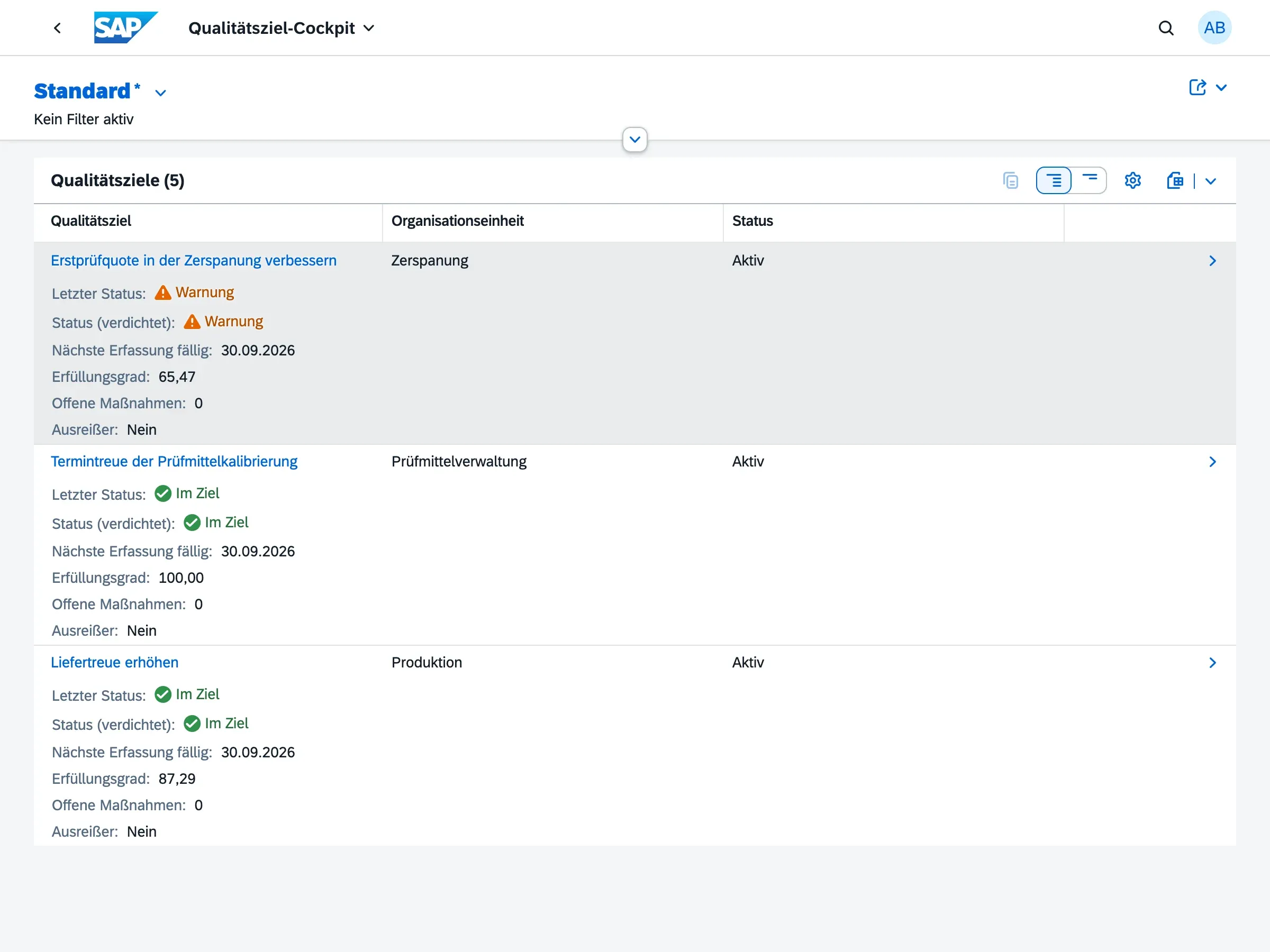
Reviewing one objective in detail doesn’t answer the question the management review under ISO 9001 9.3.2 c.4 actually asks: where does the organization stand overall? The Quality Objective Cockpit condenses every objective into one sorted list — the most critical one first — and deliberately shows two statuses side by side: the most recent single reading, and the status of the whole measurement series condensed together. One good month doesn’t clear an objective on its own if the broader trend hasn’t caught up yet.
What actually gets shown in an audit
The question in an audit is not whether an objective exists, but how it developed and where the numbers came from. Every measurement therefore carries its period, its automatically derived status, and room to explain a deviation; the objective itself records which system the number comes from.
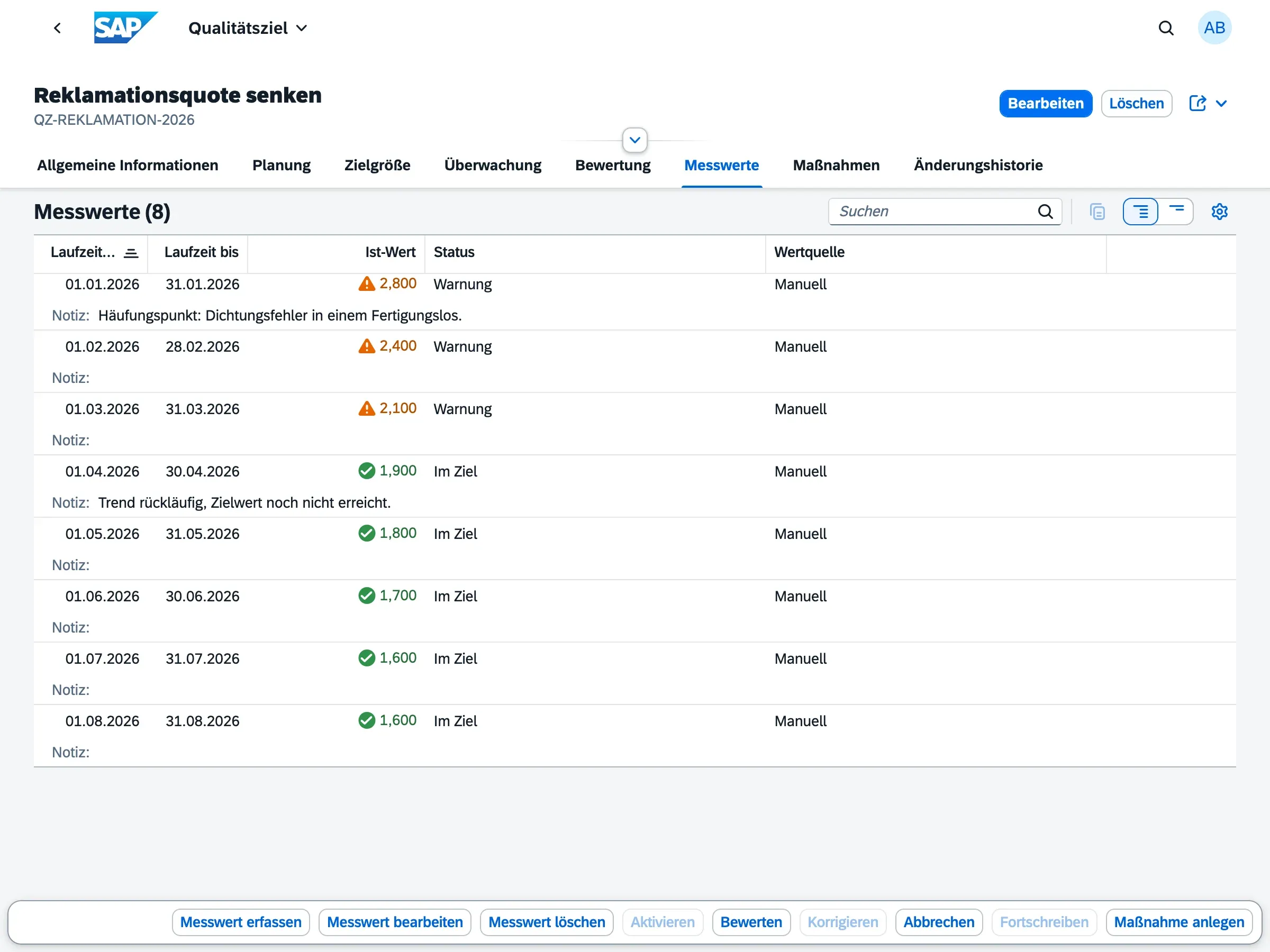
That is the difference between a claim and a record: not “the complaint rate went down”, but eight dated values showing when it went down, what got in the way in May, and who noted it.
Who this is for
Quality managers who don’t want to assemble 6.2 evidence the day of the management review. Department owners who maintain their own objectives directly instead of keeping a parallel spreadsheet. And internal or external auditors who ask about ongoing measurement — and find a history here instead of a claim.
Frequently asked questions
- Do I need an additional module for this?
- No. Quality Objectives are part of every qportal installation, with no separate license — clause 6.2 is a norm requirement, not an add-on feature. Only the cross-objective Cockpit is tied to the Insights functionality.
- Who can create objectives and record measurements?
- Creating, editing, and evaluating an objective is reserved for the Quality Manager role. Recording measurements is also open to the objective's own designated responsible person — so the number doesn't have to be relayed to the quality team by email first.
- What happens if an objective has no configured limits?
- The status still works — two-valued between on target and action required. Warning and action limits are optional and only add the in-between Warning band.
- How is this different from plain KPI tracking?
- A quality objective carries the information clause 6.2.1 and 6.2.2 actually require alongside the target value — derivation from the quality policy, the resources needed, the evaluation method — plus its own lifecycle with an evaluation at period end. A plain metric is a special case of a quality objective, not the other way round.
- Can the numbers come from ERP or MES automatically?
- There is no file import in the UI. Recording a measurement is a regular OData action, though, which an existing integration tool can call — the usual route for monthly figures from an upstream system. Every measurement carries a value source, so an audit can still tell machine-fed figures from hand-entered ones.
- What if an objective cannot sensibly be expressed as a number?
- It is still a quality objective. The ISO 9001 Auditing Practices Group states explicitly that objectives must be measurable and verifiable, but not necessarily quantified. In practice that means an objective of the met/not-met kind is kept as a two-value target metric, and the evaluation at period end rests on the evidence rather than on a decimal place. The article on quality KPIs goes into this in detail.